
SP6: The Point Behind Nearly Every Fertility Protocol
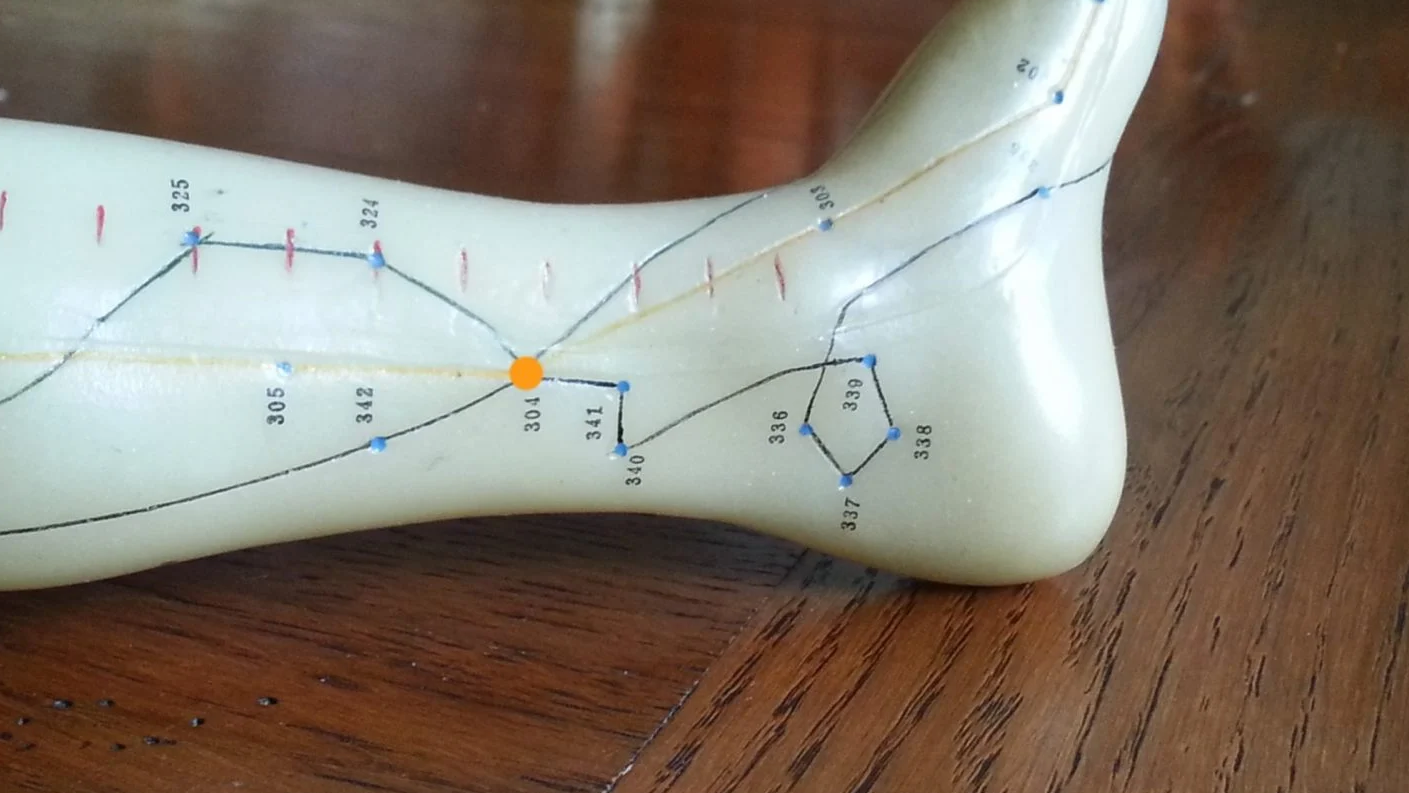
If you've had acupuncture for fertility support, there's a good chance a needle has gone into a point on the inside of your lower leg, just above the ankle. That's SP6, known in Chinese medicine as Sanyinjiao, or "Three Yin Intersection." It's one of the most used points in reproductive acupuncture, and it earns that reputation honestly. Here's what it is, why it matters for fertility specifically, and what the research actually shows.
Where It Is and Why the Name Matters
SP6 sits about three finger-widths above the inner ankle bone, along the back edge of the shinbone. Its name comes from what happens right at that spot: it's the meeting point of three important pathways in the body, the Spleen, Liver, and Kidney channels, all converging in one place.
Here's why that matters for fertility specifically. In Chinese medicine, each of these three systems plays a direct role in reproductive health:
Spleen governs digestion, which builds the Blood and oxygen your body needs to support a healthy cycle and, eventually, a pregnancy.
Liver keeps Blood and oxygen flowing smoothly, and is closely tied to regular, pain-free menstrual cycles.
Kidney is considered the root of reproductive capacity in Chinese medicine, tied to egg quality and ovarian reserve.
Because SP6 touches all three at once, it's considered one of the single most useful points for fertility and women's health in general, not just for conceiving, but for irregular cycles, PCOS, and painful periods too.
Studies have found that stimulating SP6 (often with gentle electrical stimulation) may encourage better blood flow to the ovaries and support the development of follicles. Other research has found it may calm inflammation in the body. Several clinical trials and a recent analysis of combined studies found that acupuncture protocols including SP6 were linked to a thicker uterine lining, more eggs retrieved, and better embryo quality in women with PCOS going through IVF. This directly supports why SP6 shows up so often in fertility treatment: a thicker, healthier uterine lining is one of the key factors in successful embryo implantation.
SP6 is the single most studied point for menstrual pain, with a solid body of research behind it. Since period pain and underlying cycle health are closely connected in Chinese medicine, this is often one of the first signs a patient's cycle is coming into better balance.
It's a regular part of embryo transfer protocols. In IVF cycles, SP6 is frequently used around the time of embryo transfer, aimed at supporting the uterine lining and calming nerves during an understandably stressful moment.
An Important Safety Note
SP6 is traditionally avoided during pregnancy. It's one of the points associated with encouraging uterine contractions, which is actually why it's sometimes used near the end of pregnancy to help prepare the body for labor. If you're already pregnant, a well-trained practitioner will avoid this point (or use it very deliberately, only in specific late-term situations). This is exactly why fertility acupuncture should be done by someone trained specifically in reproductive care, not general wellness acupuncture.
What This Looks Like in Practice
In a typical fertility-focused session, SP6 is usually paired with a couple of other points on the lower abdomen and leg, sometimes with gentle electrical stimulation added for a more sustained effect. Which points are used, and when, depends on where you are in your cycle or treatment timeline, whether that's early in your cycle, around egg retrieval, or just before an embryo transfer.
If you're navigating fertility treatment and want acupuncture support built around your specific protocol and timeline, we're here to help. We're located in Centennial and work closely with patients going through IVF, including many coming from CCRM Fertility in Lone Tree. Book a visit to talk through where you are in your journey.
This post is for educational purposes only and is not medical advice. Acupuncture is a supportive therapy and does not replace care from your physician or reproductive endocrinologist. Individual results vary, and no outcome is guaranteed.
(Smith CA, de Lacey S, Chapman M, et al. 1990-1998), (Yi L, Zhang H, Tian T, et al. 2026), (Ma T, Cui P, Tong X, et al. 2018), (Ho M, et al. 2009)
https://www.ncbi.nlm.nih.gov/pmc/articles/PMC3135881/
https://pmc.ncbi.nlm.nih.gov/articles/PMC12368429/
https://www.medrxiv.org/content/10.1101/2023.09.24.23296053.full.pdf