
Dry Needling in Centennial, CO
Hawthorne Acupuncture & Integrated Medicine is an acupuncture clinic in the Denver area, located in Centennial and serving Denver, Highlands Ranch, Lone Tree, Parker, and Aurora, that offers dry needling for muscle pain, sports injuries, and stubborn trigger points. Dry needling is performed by Dr. Cheryl Kujawinski, DACM, L.Ac., a doctorate-trained acupuncturist who combines trigger-point dry needling with traditional acupuncture for faster pain relief and sports recovery.
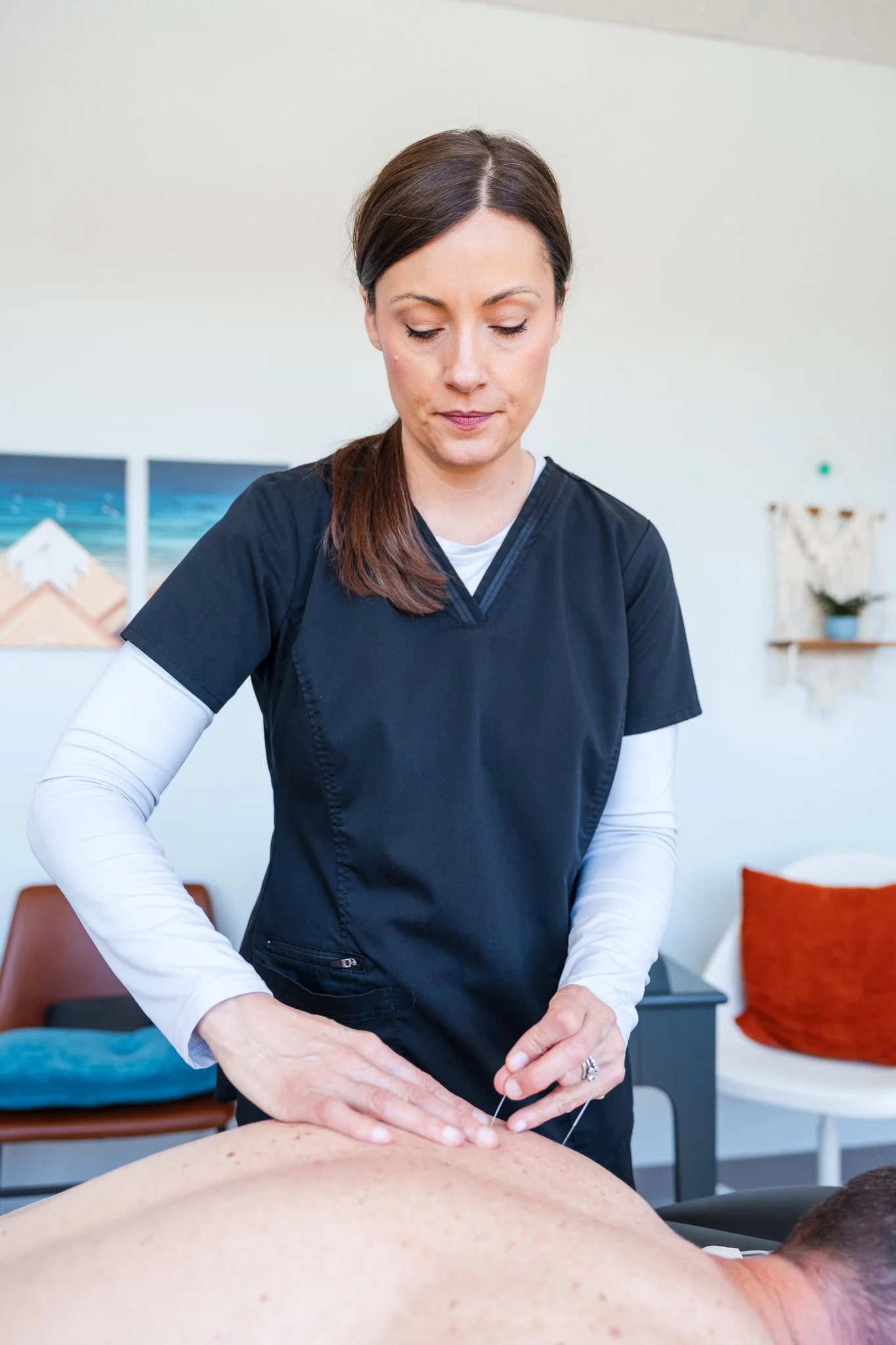
What is Dry Needling?
Dry needling is a technique that uses thin, sterile filiform needles to release myofascial trigger points — the tight, tender knots in muscle that cause pain, limit range of motion, and refer discomfort to other areas of the body.
The needle is inserted directly into the trigger point, where it disrupts the contracted band of muscle fiber and produces a local twitch response. That twitch is the muscle releasing.
It's called "dry" because nothing is injected. Trigger point injections deliver lidocaine or a corticosteroid; dry needling uses the needle itself as the therapeutic tool. No medication, no side effects from a drug.
How It Works

Releases the Trigger Point
The needle mechanically disrupts the contraction knot, interrupting the pain-spasm cycle that keeps the muscle locked.

Trigger points restrict local circulation. Needling brings oxygenated blood back into the tissue and flushes metabolic waste.
Restores Blood Flow

Needle stimulation triggers your body's natural pain-relieving chemistry through the central nervous system.
Releases Endorphins
Improves Mobility
When the muscle releases, range of motion returns, often within the same session.
Wondering whether electrical stimulation counts as dry needling? In many clinics it does, more on that below.
What Dry Needling Treats
Dry needling is most effective for musculoskeletal pain with a muscular component. Patients travel to Hawthorne from Centennial, Highlands Ranch, Lone Tree, and Parker for:
Low back pain
Neck tension and stiffness
Whiplash
Sciatica
SI joint pain
Postural strain from desk work
Back, Neck & Spine
IT band syndrome
Plantar fasciitis
Tennis and golfer's elbow
Rotator cuff pain
Hamstring and calf strains
Hip flexor tightness
Shin splints
Runner's knee
Sports & Overuse
Tension headaches
Migraines with muscular trigger
TMJ and jaw clenching
Carpal tunnel syndrome
Myofascial pain syndrome
Fibromyalgia
Neuropathy
Head, Jaw & Nerve
Training Behind the Needle
Needling is the foundation of acupuncture training, not an add-on to it. Becoming a licensed acupuncturist means a four-to-five-year graduate program built around needle technique — anatomy, depth, angle, tissue response, and safety across every region of the body — followed by over a thousand hours of supervised clinical practice before independent treatment is permitted. After that comes a national board exam through the NCCAOM and separate certification in Clean Needle Technique.
Other providers can add needling to their practice through continuing education. The requirements vary by profession and by state.
| Licensed Acupuncturist (L.Ac.) | |
|---|---|
| Program length | 4–5 year graduate degree |
| Supervised clinical hours | 1,000+ |
| National board certification | NCCAOM |
| Clean Needle Technique | Required for licensure |
| Scope | Full-body needling, all regions and depths |
| Continuing education | Required annually to maintain licensure |
Dr. Cheryl Kujawinski holds a Doctorate of Acupuncture and Chinese Medicine and is nationally board certified through the NCCAOM. At Hawthorne, dry needling is delivered by a clinician whose entire training is built around the needle.

Dry Needling vs. Acupuncture What's the Difference?
You'll see this framed as a hard divide: dry needling is "Western and evidence-based," acupuncture is "energy and qi." That's marketing, not physiology.
Both use the same filiform needles. Both work through the nervous system — mechanical stimulation of tissue that triggers neurochemical and circulatory responses. The research on needle-induced vasodilation and endorphin release doesn't distinguish between them.
The real difference is scope. Dry needling is a localized application: find the trigger point, release it, restore movement. Acupuncture includes that same technique and adds systemic treatment — the ability to address the sleep, stress, digestion, or hormonal factors that may be feeding the pattern in the first place.
If you came here for trigger point release, that's exactly what you'll get. If it turns out your shoulder pain is tied to how you're sleeping or how much stress you're carrying, acupuncturists are trained to treat that too.
What to Expect During a Session
1. Assessment
We talk through your pain, movement limitations, training history, and what makes it better or worse. We palpate to locate the trigger points that are actually driving your symptoms, which often aren't where you feel the pain.
2. Positioning
You'll lie face up or face down depending on the area being treated. Wear shorts and a t-shirt, or bring them to change into.
3. Needling
Needles go in directly at the trigger point. You may feel a brief deep ache and a twitch, which is the muscle contracting and letting go. That twitch is the goal.
4. Time on the table
Depending on the area, needles stay in anywhere from a few seconds to about 20 minutes.
5. After
Needles are removed. Expect soreness similar to a hard workout for 24–48 hours. Occasional light bruising can last up to a week. Hydrate, and skip a heavy training session that day.
Most patients notice a change in range of motion before they leave the table. Pain relief typically follows within 24 to 48 hours.

Electroacupuncture, E-Stim, and "Electric Dry Needling"
If you've had needling with electrical stimulation somewhere else, you may have heard it called electric dry needling, EDN, or percutaneous electrical nerve stimulation. Patients often ask whether that's the same thing we are doing when we clip the leads on. Functionally, yes. Needles placed in the tissue, a low-level current run between them.
The naming just reflects who's doing it. Physical therapists and chiropractors who add current to dry needling call it electric dry needling. Acupuncturists call it electroacupuncture. Same principle, different professional vocabulary.
What the current adds is a sustained pumping contraction rather than a single twitch. That drives deeper release, stronger circulatory response, and better results for chronic tendinopathy, long-standing myofascial pain, and nerve-related symptoms.
The practical difference is range. E-stim protocols taught in a certification course cover a defined set of applications. Acupuncture training covers frequency selection, waveform, and point pairing across the whole body, including the systemic applications that fall outside a musculoskeletal-only scope.
If you have a pacemaker or any implanted electrical device, let me know — see below.

Dry Needling During Pregnancy
Most clinics list pregnancy as a flat contraindication. That's a training limitation, not a clinical one.
Pregnancy brings real musculoskeletal pain, SI joint dysfunction, sciatica, round ligament pain, upper back strain from postural change. These respond well to needling. What matters is knowing which points and regions to avoid, and that's part of standard acupuncture training rather than a weekend certification.
Our office treats prenatal patients throughout pregnancy and adjusts our technique by trimester.
When Dry Needling Isn't Appropriate
Let me know before your appointment if any of these apply:
You take blood thinners or have a clotting disorder
You have an active infection or skin condition at the treatment site
You've had surgery in the area recently
You're immunocompromised
You have a significant needle phobia
You have a pacemaker or implanted electrical device (relevant for electroacupuncture)
In most of these cases there are still options, we'll talk through what makes sense during your consultation.
Frequently Asked Questions About Dry Needling
-
You'll feel the needle go in, though most people describe it as less than a pinch. When the needle reaches the trigger point you may feel a deep ache and a twitch which is brief, and usually followed by immediate release. It shouldn't be sharply painful. If it is, tell me and I'll adjust.
-
Most people feel muscle soreness for 24 to 48 hours, similar to the day after a hard workout. Some feel nothing. Light bruising happens occasionally and can last about a week.
-
Acute issues often resolve in 2–4 sessions. Chronic or long-standing patterns typically take longer and may need weekly treatment for several weeks before spacing out. We'll set expectations at your consultation.
-
Light movement is fine and often helpful. I'd skip heavy lifting or hard training the same day because the muscle has been worked and needs some time to recover.
-
Hawthorne doesn't bill insurance directly, but many plans cover acupuncture services for pain conditions. Call your insurer to ask about out-of-network acupuncture coverage. If they cover it, I'll provide a superbill with proper coding to submit for reimbursement. HSA and FSA cards are accepted.
-
No. You can book directly.
-
They use the same needles and work through the same physiological mechanisms. Dry needling is the localized musculoskeletal application; acupuncture is the broader system that includes it. If you want trigger point work, that's what you'll get.
-
When a physical therapist or chiropractor runs current through needles, it's often called electric dry needling. When I do it, it's called electroacupuncture. Same underlying technique.
-
Massage works from the outside in and can be limited by how deep the therapist can reach. A needle accesses trigger points directly, including layers that hands can't get to.
Ready to Move Better?
Dry needling appointments are available at Hawthorne Acupuncture & Integrated Medicine in Centennial, serving the south Denver metro.